



DR. SUNFLOWER™️ | SCHOLARSHIP IN BLOOM™️

Research is Resistance.
Scholarship is Liberation.

Scholarship in Bloom™️ is a digital home for justice-centered research, public scholarship, and visual storytelling.

Grounded in Black women’s lived experiences, this work explores identity, policy, professionalism, institutional power, and the distance between inclusion and meaningful representation. Through research, teaching, writing, and advocacy, I invite conversations that question accepted narratives, center historically marginalized knowledge, and imagine more equitable institutions.

ROOTED IN RESEARCH. CROWNED BY PURPOSE. BLOOMING WITHOUT PERMISSION.™️

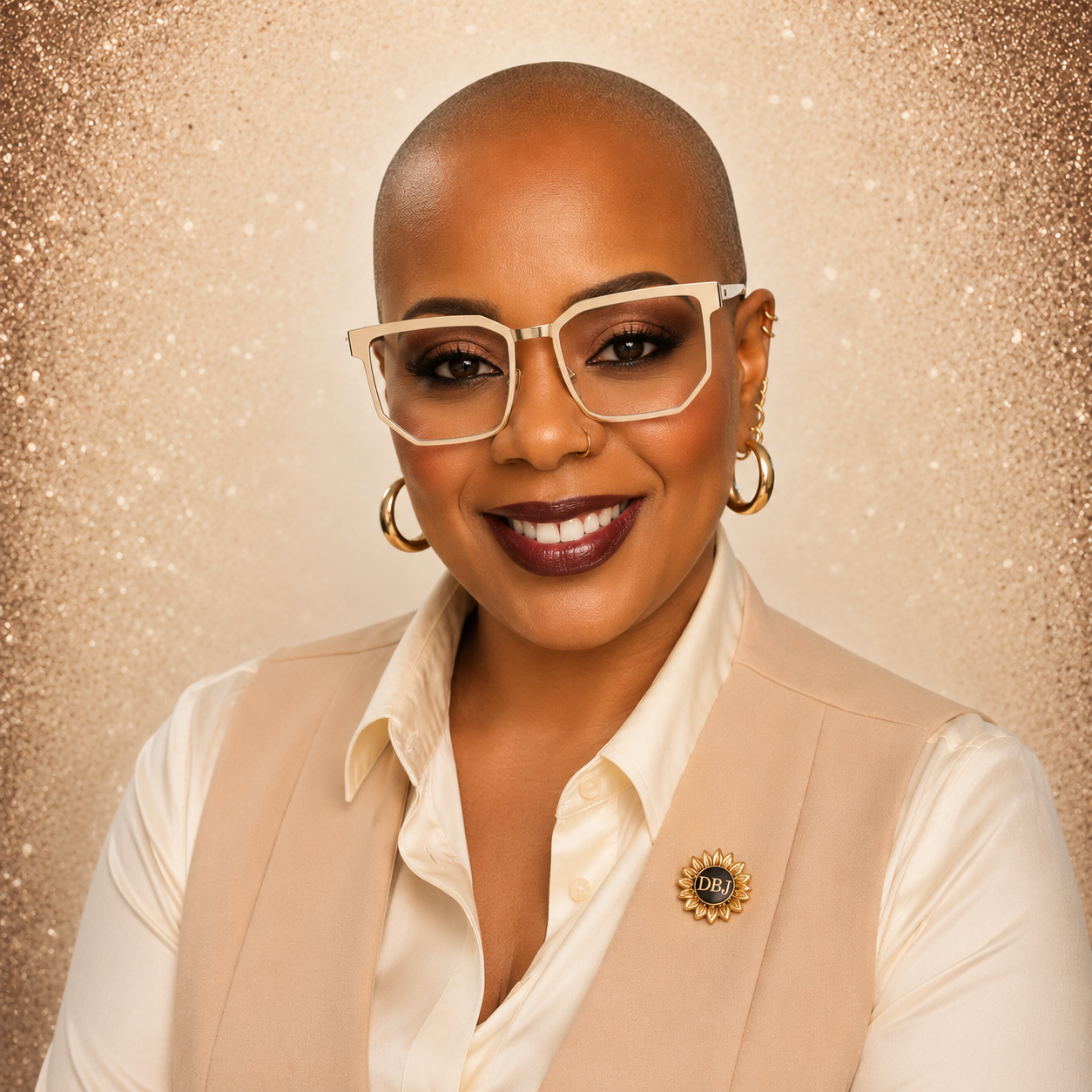
Dr. Dana Bazemore-Jolly in a cream and champagne professional portrait against a warm, softly sparkling background.
Crowned in Bloom emblem featuring a close-cropped Black woman framed in gold with a metallic sunflower and jeweled flourishes.

FEATURED VISUAL • SCHOLARSHIP IN BLOOM™️

Liberation Looks Good on You.

A visual declaration of becoming, purpose, scholarship, and liberation.

Dr. Dana Bazemore-Jolly smiles in a tailored chocolate-and-bronze suit with white statement glasses, surrounded by golden sunflowers, butterflies, a crown, and the words Liberation Looks Good on You.
LIBERATION LOOKS GOOD ON YOU. • DR. SUNFLOWER™️

This image reflects the heart of Scholarship in Bloom™️: justice-centered scholarship, purposeful becoming, and the power of living fully in one’s truth.
It is more than a portrait. It is a statement.

Dr. Dana Bazemore-Jolly Doctor of Social Work
Justice-Centered Scholar • Educator • Advocate • Dream-Builder

Explore Scholarship in Bloom™️

Scholar. Educator. Advocate. Dream-Builder.

Dr. Dana Bazemore-Jolly is a justice-centered scholar whose work examines the relationship between identity, policy, institutional culture, power, and lived experience.

Her scholarship is particularly concerned with the experiences of Black women navigating institutions that may recognize their labor, expertise, and contributions while simultaneously scrutinizing aspects of their identity.

Her doctoral research examined the lived experiences of 32 Black women who wear their natural hair and explored the impact of the CROWN Act on those experiences.

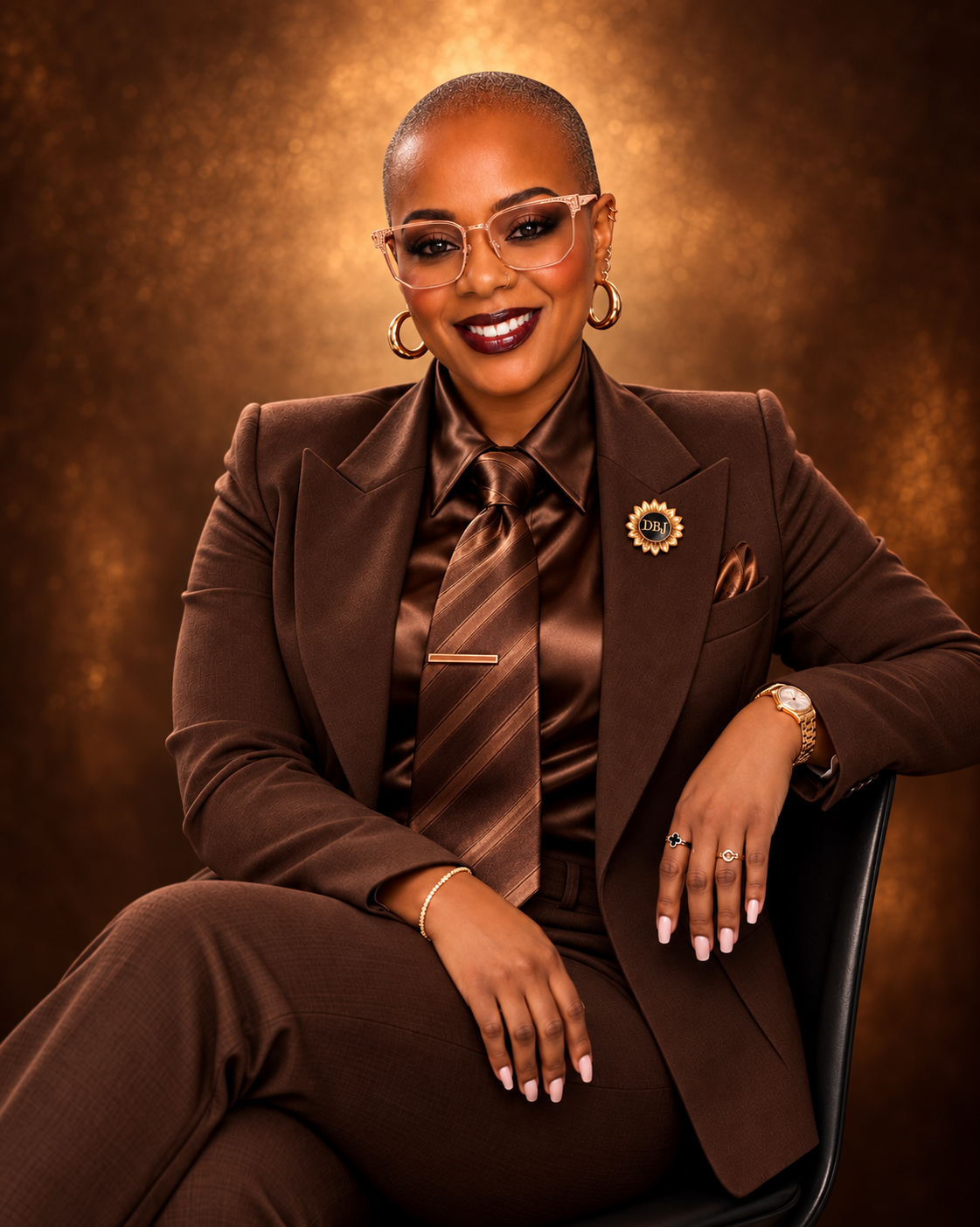
Dr. Dana Bazemore-Jolly in a tailored chocolate-brown pantsuit, satin shirt, coordinating necktie, glasses, and DBJ sunflower pin against a copper-bronze studio background.
Who gets to decide what professionalism looks like?

Justice-Centered Scholar • Educator • Advocate • Dream-Builder

THE COMMITMENTS BEHIND THE WORK

The Justice-Centered Scholar Manifesto

Justice-Centered Scholar Manifesto by Dr. Dana Bazemore-Jolly, declaring her beliefs, commitments, practices, values, and pledge to Black women and girls. Complete text is available below.
Read the manifesto

I research. I teach. I advocate. I transform.

Rooted in truth. Guided by justice. Committed to liberation.

I Believe

  • Knowledge is a tool for liberation.
  • Black women’s experiences are worthy of study, respect, and celebration.
  • Justice is not optional—it is the foundation.
  • Our stories are sacred, our voices are power, and our truth heals.

I Commit

  • To center justice in all I research, teach, and write.
  • To disrupt systems of bias, inequity, and oppression.
  • To elevate underrepresented voices and community wisdom.
  • To bridge theory and practice for real-world transformation.

I Practice

  • Cultural humility and lifelong learning.
  • Ethical scholarship that serves humanity.
  • Mentorship, collaboration, and collective empowerment.
  • Courage, compassion, and consistency in the pursuit of justice.

I Stand For

  • Equity over equality
  • Liberation over oppression
  • Community over individualism
  • Education over ignorance
  • Healing over harm
  • Legacy over comfort

I Pledge

To use my voice, my scholarship, and my platform to create a world where Black women and girls are seen, respected, and free to thrive—crowned in their humanity and limitless in their potential.

This work is liberation. It is my purpose. It is my calling. It is my legacy.

Natural hair is professional.

I support the CROWN Act 2026.

We wear the crown. We write the story. We change the world.

Dr. Dana Bazemore-Jolly · Doctor of Social Work

Social Worker · Educator · Advocate · Justice-Centered Scholar · CROWN Act Champion · Dream-Builder · Practitioner

The Presence You Have

What first impressions reveal, what they miss, and what becomes clear when people look beyond the surface.

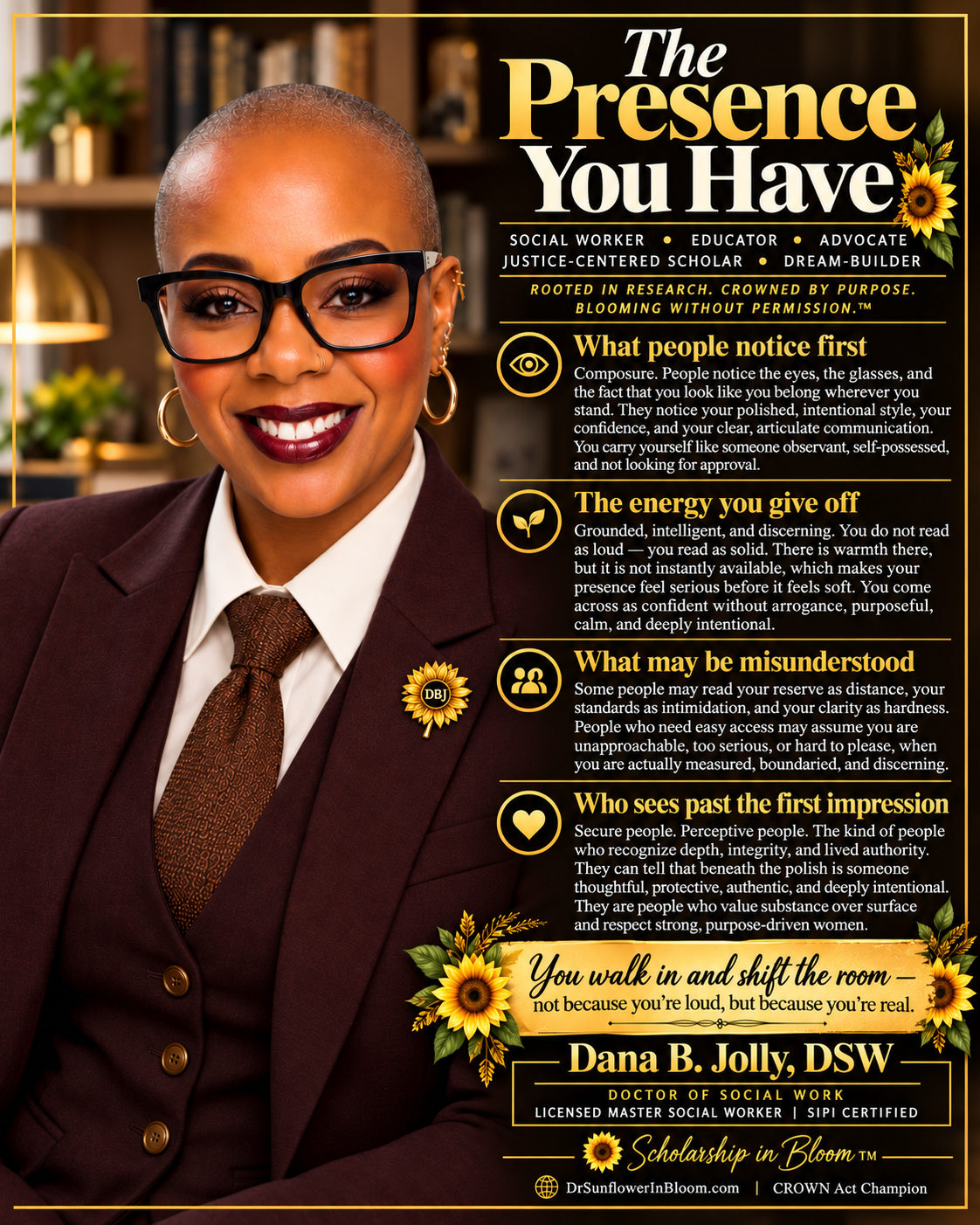
The Presence You Have, a Scholarship in Bloom editorial portrait of Dana B. Jolly, DSW, smiling in a burgundy three-piece suit and tie, black glasses, and a DBJ sunflower lapel pin. Gold and cream headings explore what people notice first, the energy she gives off, what may be misunderstood, and who sees beyond the first impression. A complete text version follows the image.
Dana B. Jolly, DSWSelect the poster to view its full-size typography.
Read the complete reflection as text

What people notice first

Composure. People notice the eyes, the glasses, and the fact that you look like you belong wherever you stand. They notice your polished, intentional style, your confidence, and your clear, articulate communication. You carry yourself like someone observant, self-possessed, and not looking for approval.

The energy you give off

Grounded, intelligent, and discerning. You do not read as loud; you read as solid. There is warmth there, but it is not instantly available, which makes your presence feel serious before it feels soft. You come across as confident without arrogance, purposeful, calm, and deeply intentional.

What may be misunderstood

Some people may read your reserve as distance, your standards as intimidation, and your clarity as hardness. People who need easy access may assume you are unapproachable, too serious, or hard to please, when you are actually measured, boundaried, and discerning.

Who sees past the first impression

Secure people. Perceptive people. The kind of people who recognize depth, integrity, and lived authority. They can tell that beneath the polish is someone thoughtful, protective, authentic, and deeply intentional. They are people who value substance over surface and respect strong, purpose-driven women.

You walk in and shift the room, not because you are loud, but because you are real.

Dana B. Jolly, DSW
Doctor of Social Work • Licensed Master Social Worker • SIPI Certified
Scholarship in Bloom™️ • CROWN Act Champion

🌻 THE OTHER SIDE OF THE TABLE

Who Gets Context, and Who Gets Judged?

A featured publication from the Monday essay series. Upcoming installments are listed below.

Scholarship in Bloom: The Other Side of the Table. Who Gets Context, and Who Gets Judged? Editorial artwork by Dr. Dana Bazemore-Jolly.

We talk a great deal about getting a seat at the table.
But what happens once someone sits down?

Who is believed?
Whose professional judgment is respected?
Whose concerns are dismissed as emotional, personal, or confrontational?

As social workers, we are trained to understand people within the environments that shape their experiences.
Yet in organizational settings, context can be selectively applied.

A developing professional may be labeled “not a good fit” before anyone meaningfully examines the guidance, support, or opportunities they received.
People may scrutinize a person's reaction while leaving the circumstances that preceded it unexplored.

A professional's informed disagreement may be interpreted as defensiveness rather than a legitimate challenge to an institutional decision.

And when a Black woman challenges an assessment, is her professional reasoning evaluated, or is she told she is taking things personally?
Sometimes the problem is not the absence of context.
It is its selective application.

Compassion does not negate competence.
Disagreement does not automatically diminish credibility.
And professional dissent is not inherently a personal grievance.

For Black women, racialized and gendered expectations can further complicate how confidence, advocacy, authority, and professional judgment are perceived.

Accountability matters.
So does context.

But accountability without consistent consideration of context risks becoming something else entirely: the exercise of institutional power without sufficient examination of its consequences.

The question is not whether people should be held accountable.
The question is whether institutions will apply the same standards of fairness, inquiry, and professional respect to everyone at the table.

Before deciding who is wrong at the table, perhaps we should ask who has been allowed to tell the whole story.

🌻 Dr. Sunflower™️ | Scholarship in Bloom™️
Research • Justice • Policy • Liberation

#ScholarshipInBloom #SocialWorkLeadership #InstitutionalAccountability #BlackWomenInLeadership #JusticeCenteredScholarship

SCHOLARSHIP IN BLOOM™️ • EDITORIAL CALENDAR

Upcoming Monday Essays

WHEN INCLUSION IS COUNTED BUT REPRESENTATION IS MISSING

The Difference Between Being Included and Having Institutional Power

Scheduled • Not Yet Published

A SEAT AT THE TABLE IS NOT ENOUGH

Representation, Institutional Power, and the Responsibility to Make Room

Planned Publication • Not Yet Published

The Bloom Bank™️

Where Reflection Becomes Inquiry.

A curated collection of short-form reflections exploring Black women’s lived experiences, identity, professionalism, justice, and institutional power. Each entry begins with a question and invites deeper conversation.

Editorial graphic reading PRESSURE: When the rule is never written down, with a sunflower, gold scales of justice, books labeled Equity, Civil Rights and Belonging, and the question Did the pressure stop? Signed Dr. Dana Bazemore-Jolly.
PRESSURE: WHEN THE RULE IS NEVER WRITTEN DOWN Dr. Dana Bazemore-Jolly

FOUNDING REFLECTION • OCTOBER 2026

PRESSURE: WHEN THE RULE IS NEVER WRITTEN DOWN

Black Women, Natural Hair, and the Unwritten Rules of Professionalism

How expectations shape decisions long before anyone puts a rule in writing.

“Pressure lives between bias and behavior.”

Natural Hair Professionalism Institutional Power

Read Full Reflection Expand the complete essay

One word stopped me:

Pressure.

Because sometimes no one has to tell a Black woman that her natural hair is unacceptable.

The message can arrive through what gets complimented, questioned, rewarded, or quietly treated as “professional.”
Through watching who gets hired, promoted, trusted, placed in front of clients, or invited into rooms where decisions are made.
Eventually, a rule doesn't have to be written down if people have learned to anticipate it.

Pressure lives between bias and behavior.

We often recognize discrimination after something tangible happens. But what happens before the consequence?

What happens when a Black woman has already learned enough about an environment to modify herself before anyone has the opportunity to penalize her?

She may wonder whether braids will affect how seriously she is taken.
She may change her hair before an interview so it does not become one more variable by which her qualifications are judged.

We may call those choices practical, strategic, or necessary.
But necessary because of what?

The CROWN Act can prohibit discrimination.

But legislation cannot reach every raised eyebrow, coded suggestion, preference disguised as advice, or internal calculation made before walking through a workplace door.

Law and culture do different work.

A woman can possess the right to wear her natural hair while still inhabiting an environment that makes exercising that right feel professionally risky.
That space between protection and belonging deserves our attention.

Sometimes power does not need to issue an order.
Sometimes it creates enough pressure that people begin giving the order to themselves.

The law may have changed.

But we still have to ask:
Who is carrying the pressure?

#CROWNAct #NaturalHair #BlackWomen #Professionalism #WorkplaceEquity

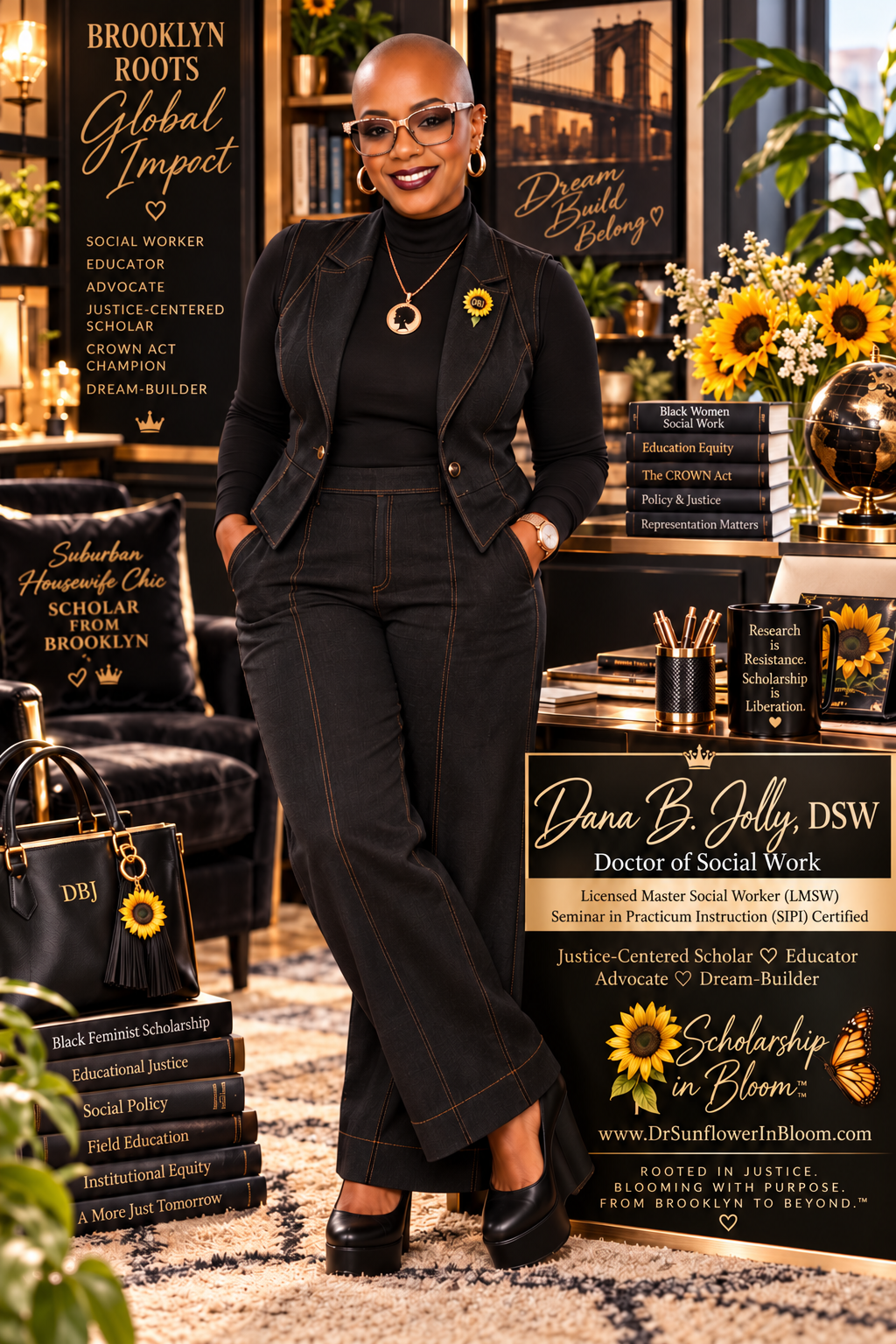
Full-length branded portrait of Dana B. Jolly, DSW, dressed in a tailored black vest and trousers with a turtleneck, statement glasses, jewelry and platform wedges, standing in a warm black-and-gold scholarly office with Brooklyn Bridge art, sunflowers and books.
SUBURBAN HOUSEWIFE CHIC SCHOLAR FROM BROOKLYNDana B. Jolly, DSW

SPECIAL REFLECTION • OCTOBER 25, 2026

SUBURBAN HOUSEWIFE CHIC SCHOLAR FROM BROOKLYN

On Identity, Authenticity, and the Freedom to Be Every Version of Myself

Brooklyn roots, suburban housewife chic, and scholarly purpose. One woman, every version of herself.

“My scholarship is rigorous. My personality does not have to be rigid.”

Identity Authenticity Professional Freedom

By Dana B. Jolly, DSW

Read Full Reflection Expand the complete essay

I am a suburban housewife.

I am a Brooklyn girl.

I am a social worker, educator, advocate, and Doctor of Social Work.

And depending on the day, I might show up wearing a tailored vest, a necktie, rose-gold jewelry, and four-inch platform wedges.

I see no contradiction.

I see a woman who has learned that she does not have to choose between the different parts of herself.

I grew up in Brooklyn during the 1980s, when personal style was practically a second language.

We dressed for school. And yes, I wore leather suits, heels, and hats.

I found my people among the performing arts crowd. I started in stage crew, moved into rhythm and percussion, and eventually found myself singing and dancing.

By senior year, my classmates voted me Most Talented.

But what I remember most is not the recognition.

It was the freedom.

The freedom to express myself without asking permission to be someone else.

Somewhere along the way, adulthood introduced responsibilities, expectations, and environments where individuality was not always celebrated.

Like many Black women, I learned that professional credibility could come with unspoken expectations about appearance, expression, and behavior.

And sometimes, being taken seriously meant carefully considering which parts of myself other people would find acceptable.

Today, I live in the suburbs. I love my home, my husband, and the life we are building.

I also love scholarship, teaching, research, beautiful clothes, statement glasses, and a really good necktie.

My personal style is both feminine and androgynous.

My scholarship is rigorous. My personality does not have to be rigid.

The suburbs did not erase Brooklyn.

The doctorate did not erase the performer.

And becoming a wife did not erase the independent woman with dreams, opinions, and a voice of her own.

I have spent too many years becoming this woman to reduce her to someone else's definition of professional, feminine, scholarly, or acceptable.

Because intellectual authority does not require aesthetic conformity.

And authenticity should not be the price we pay for professional credibility.

The girl from Brooklyn did not disappear when I became Dr. Jolly.

She came with me.

And apparently, she still knows how to dress.

I am Suburban Housewife Chic.

I am a Scholar from Brooklyn.

And I am not choosing between them.

So here's my question:

Who taught us that being taken seriously required leaving parts of ourselves behind?

Dana B. Jolly, DSW
🌻 Scholarship in Bloom™️

Rooted in Justice. Blooming with Purpose.

BROOKLYN ROOTS. GLOBAL IMPACT.
Dream. Build. Belong.

Approved The Presence You Have editorial portrait of Dana B. Jolly, DSW, smiling in a burgundy three-piece suit, copper tie, glasses, and DBJ sunflower pin; the artwork explores composure, first impressions, authenticity and authority.
THE PRESENCE YOU HAVE Dana B. Jolly, DSW

PERSONAL REFLECTION • THE SCHOLAR BEHIND THE WORK

THE PRESENCE YOU HAVE

What first impressions reveal, what they miss, and what becomes clear when people look beyond the surface.

A reflection on personal presence, professional identity, perceived authority, and the depth that first impressions may overlook.

“You walk in and shift the room, not because you are loud, but because you are real.”

Authenticity Identity First Impressions

By Dana B. Jolly, DSW

Read Full Reflection Expand the original written reflection

What people notice first

Composure. People notice the eyes, the glasses, and the fact that you look like you belong wherever you stand. They notice your polished, intentional style, your confidence, and your clear, articulate communication. You carry yourself like someone observant, self-possessed, and not looking for approval.

The energy you give off

Grounded, intelligent, and discerning. You do not read as loud; you read as solid. There is warmth there, but it is not instantly available, which makes your presence feel serious before it feels soft. You come across as confident without arrogance, purposeful, calm, and deeply intentional.

What may be misunderstood

Some people may read your reserve as distance, your standards as intimidation, and your clarity as hardness. People who need easy access may assume you are unapproachable, too serious, or hard to please, when you are actually measured, boundaried, and discerning.

Who sees past the first impression

Secure people. Perceptive people. The kind of people who recognize depth, integrity, and lived authority. They can tell that beneath the polish is someone thoughtful, protective, authentic, and deeply intentional. They are people who value substance over surface and respect strong, purpose-driven women.

You walk in and shift the room, not because you are loud, but because you are real.

Dana B. Jolly, DSW
Doctor of Social Work • Licensed Master Social Worker • SIPI Certified
Scholarship in Bloom™️ • CROWN Act Champion

NEXT WEDNESDAY • OCTOBER 28, 2026

THE CONDITIONS OF CHOICE

Black Women, Hair, and Professional Freedom

Our next Bloom Bank™️ reflection is on deck. Its full text will appear here after publication.

Coming Soon • Not Yet Published

UPCOMING SPECIAL REFLECTION • WEDNESDAY, NOVEMBER 4, 2026

INSIDE OUT

The Woman. The Scholar. The Survivor. The Dreamer.

A personal reflection on the many versions of ourselves that shape who we are and who we are becoming.

Coming Soon • Not Yet Published

The Scholarship Behind the Conversation

Dr. Sunflower’s doctoral research explored the lived experiences of 32 Black women who wear their natural hair or protective styles and examined how participants understood the influence of the CROWN Act on those experiences.

The study placed Black women’s voices at the center of an inquiry into hair discrimination, professionalism, workplace culture, policy, identity, and institutional power.

At its core, the research asks us to consider something larger than hair: what happens when institutional standards are presented as neutral even though some people are required to negotiate more of themselves in order to meet them?

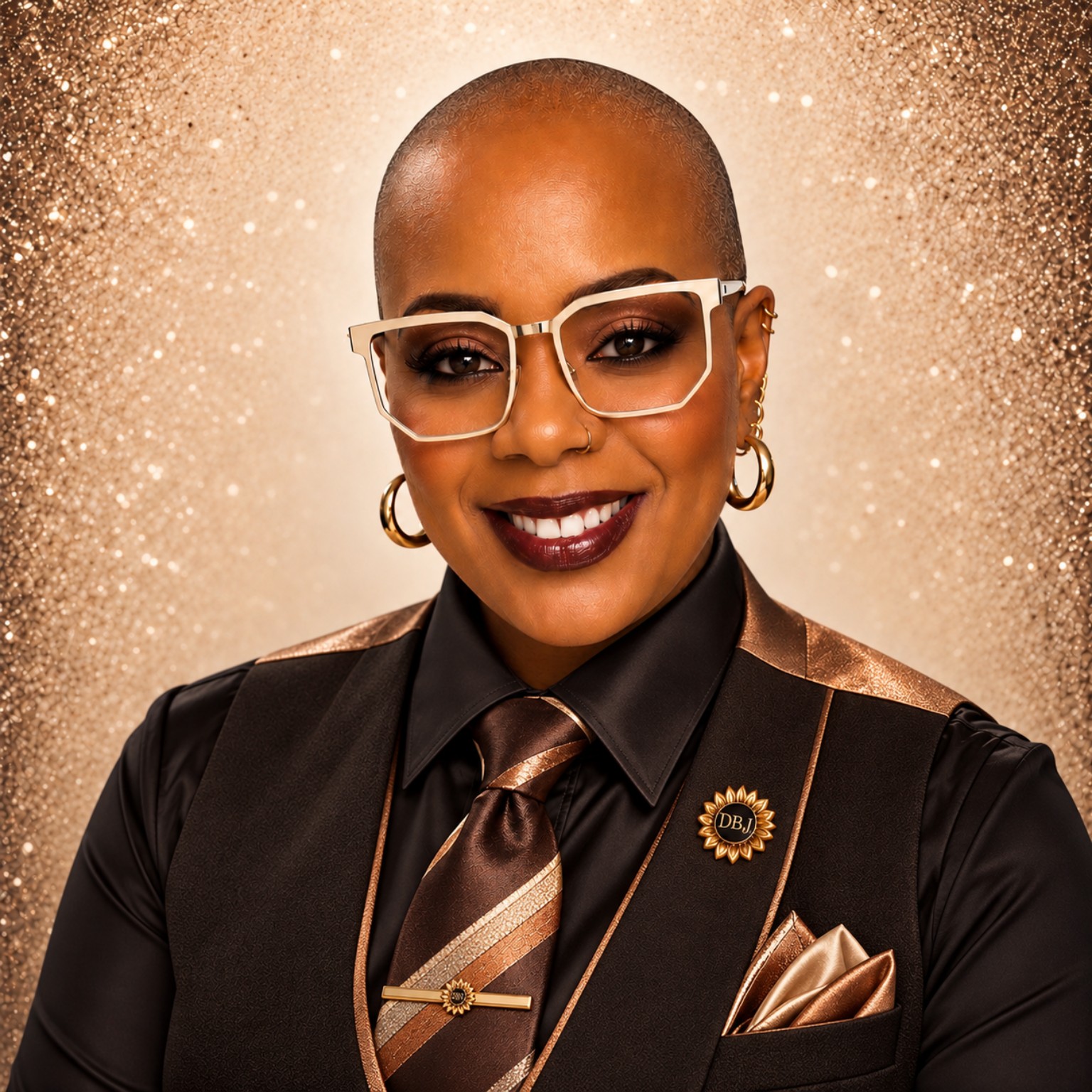
Dr. Dana Bazemore-Jolly in a black shirt, tailored vest, tie, glasses, and DBJ sunflower pin.

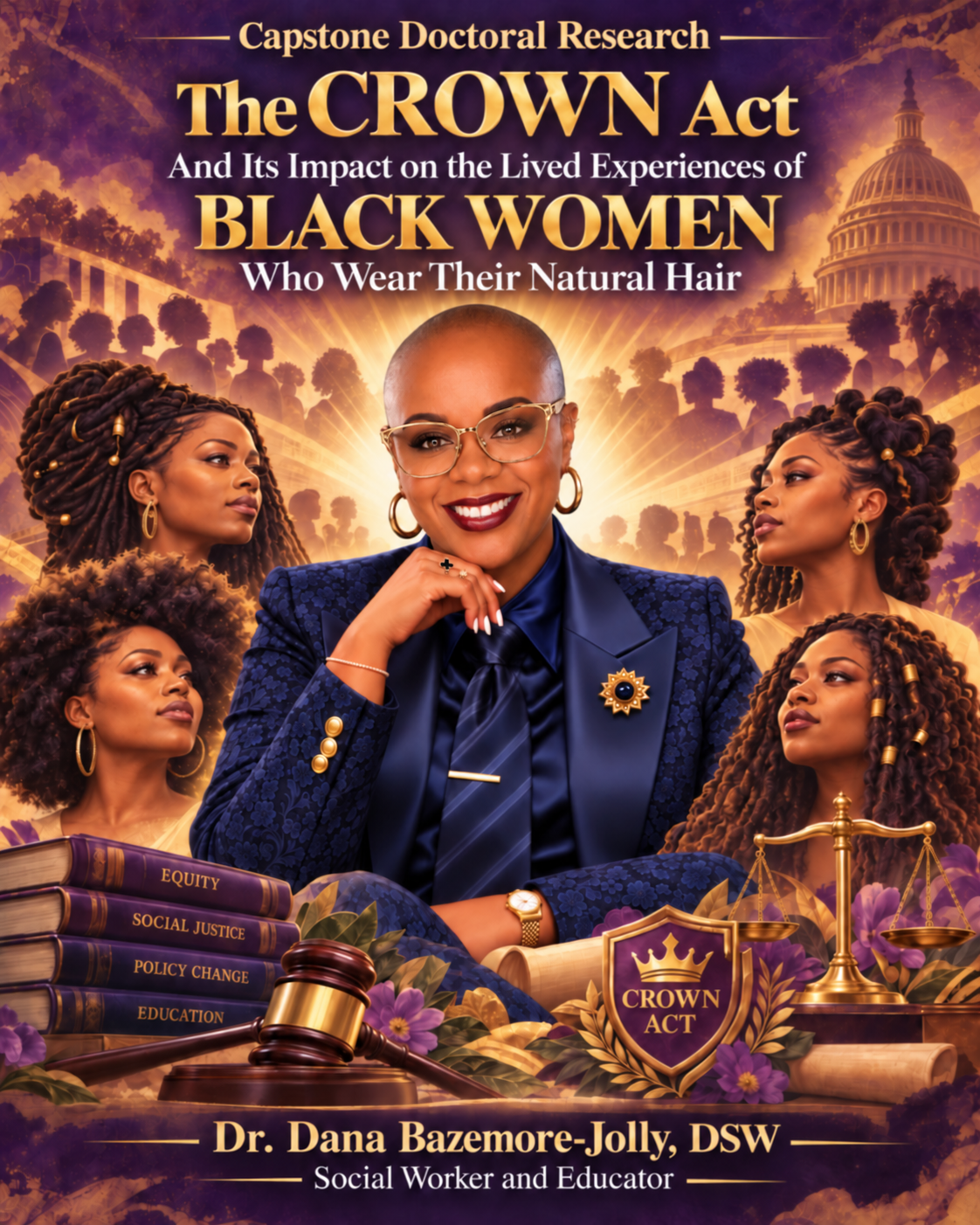
SIGNATURE RESEARCH PORTRAIT

Scholarship in Bloom™️ Signature CROWN Act Portrait

Capstone CROWN Act doctoral research portrait of Dr. Dana Bazemore-Jolly in a navy patterned suit and gold glasses, surrounded by four Black women with natural hairstyles, a United States Capitol backdrop, equity books, a gavel, scales of justice, and a CROWN Act shield.
A portrait honoring Dr. Dana Bazemore-Jolly’s capstone doctoral research on the CROWN Act and the lived experiences of Black women who wear their natural hair.
32 Voices.One Story.
Natural HairIs Professional.
Policy matters.Culture matters too.

Scholarship Beyond the Academy

Essays and commentary that carry justice-centered scholarship into public conversation.

OP-ED • SUCCESSFUL BLACK PARENTING MAGAZINE • AUGUST 19, 2026

The Family We Call “Non-Traditional” May Be Exactly What A Child Needs

Dr. Dana Bazemore-Jolly examines why family well-being should be understood through safety, consistency, care, connection, and the people who reliably show up for a child, rather than through narrow assumptions about what a family is supposed to look like.

“Our children do not need us to build perfect families. They need us to build healthy ones.”

By Dr. Dana Bazemore-Jolly • Published by Successful Black Parenting Magazine

Read the Original Op-Ed

What Scholarship in Bloom™️ Explores

Professionalism & Power

Who defines what is professional, and whose appearance, language, identity, or behavior becomes the unspoken standard?

Black Women’s Lived Experiences

What can institutions learn when Black women are treated not merely as populations to study, but as knowledge-bearers?

Policy & Justice

What happens after legislation is passed, and how do policy, culture, implementation, and practice intersect in real lives?

Public Scholarship

How can rigorous research move beyond the dissertation, classroom, and journal into meaningful public conversation?

This work is not scholarship for the shelf. It is scholarship intended to travel.

Scholarship in the Classroom

Public scholarship becomes especially powerful when it enters classrooms, invites dialogue, and helps emerging social workers connect research, policy, identity, and practice.

SAVANNAH STATE UNIVERSITY • DEPARTMENT OF SOCIAL WORK • OCTOBER 1, 2026

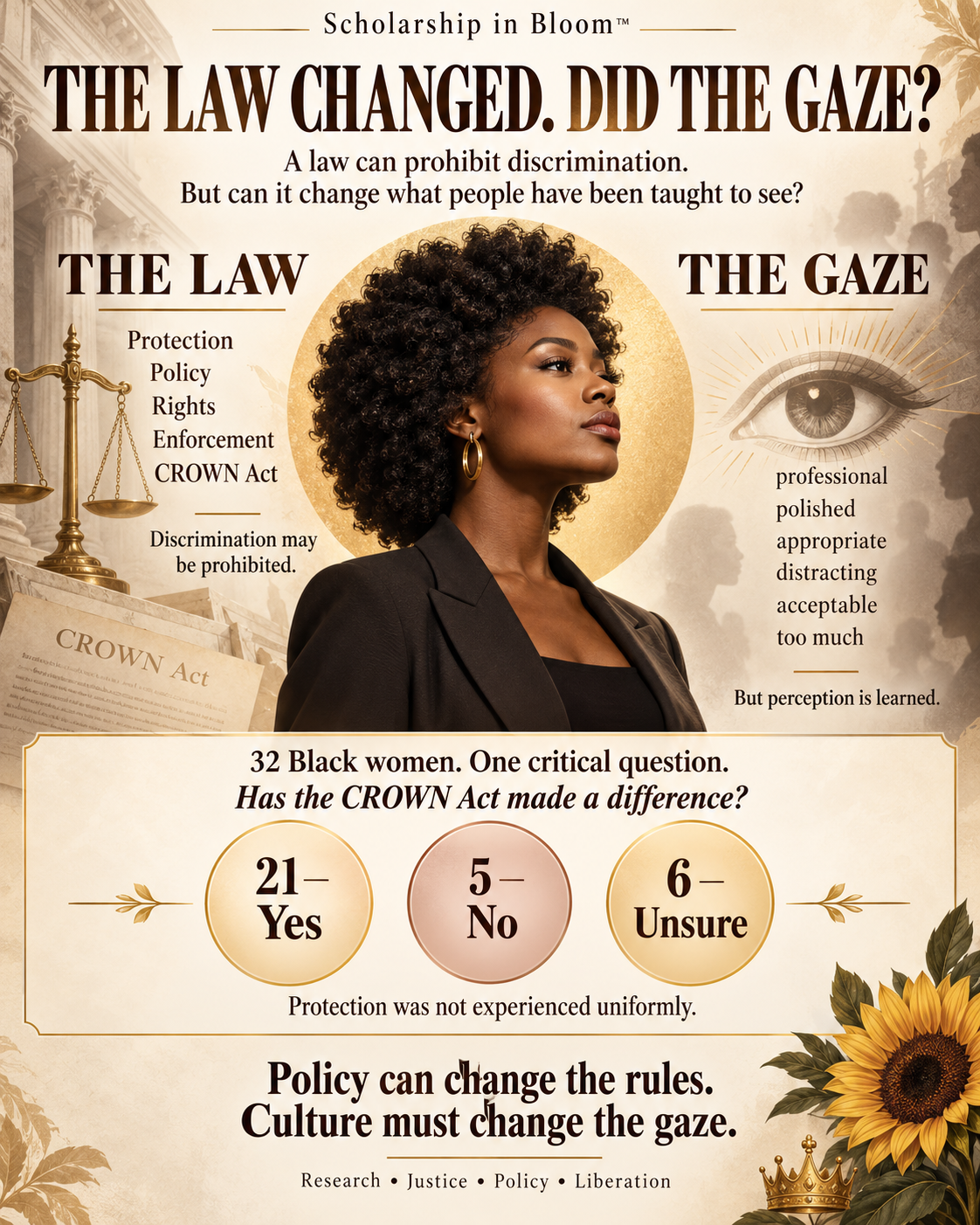
The Law Changed. Did the Gaze?

Policy, Identity, Professionalism, Bias & Social Work Practice

Savannah State University guest lecture graphic for The Law Changed. Did the Gaze? presentation.

Dr. Dana Bazemore-Jolly was invited to present virtually to MSW II students in Field Seminar III. The interactive guest lecture connected hair discrimination and the CROWN Act to professional norms, institutional culture, social work practice, supervision, advocacy, and organizational responsibility.

The session centered findings from her doctoral study of 32 Black women and asked students to examine the distance between formal legal protection and lived experience, including the question of who gets to define what looks “professional,” “polished,” or “appropriate.”

Speaker Bio

Dr. Dana Bazemore-Jolly is a Doctor of Social Work, justice-centered scholar, educator, advocate, and social work leader whose work connects policy, identity, equity, professionalism, and lived experience. Her background includes social work education, field instruction, leadership, supervision, advocacy, and doctoral research on the CROWN Act and natural hair discrimination.

“Policy can change the rules. Culture must change the gaze.”

Student feedback described the presentation as engaging, relevant, and easy to follow, and highlighted the value of connecting research with real-world social work leadership, practice, supervision, and professional development. Students indicated they would recommend Dr. Bazemore-Jolly for future classes and student programming.

Guest Lecture • MSW II • Field Seminar III • Presented virtually via Microsoft Teams • Certificate of Appreciation awarded by Savannah State University

Scholarship in Bloom™️

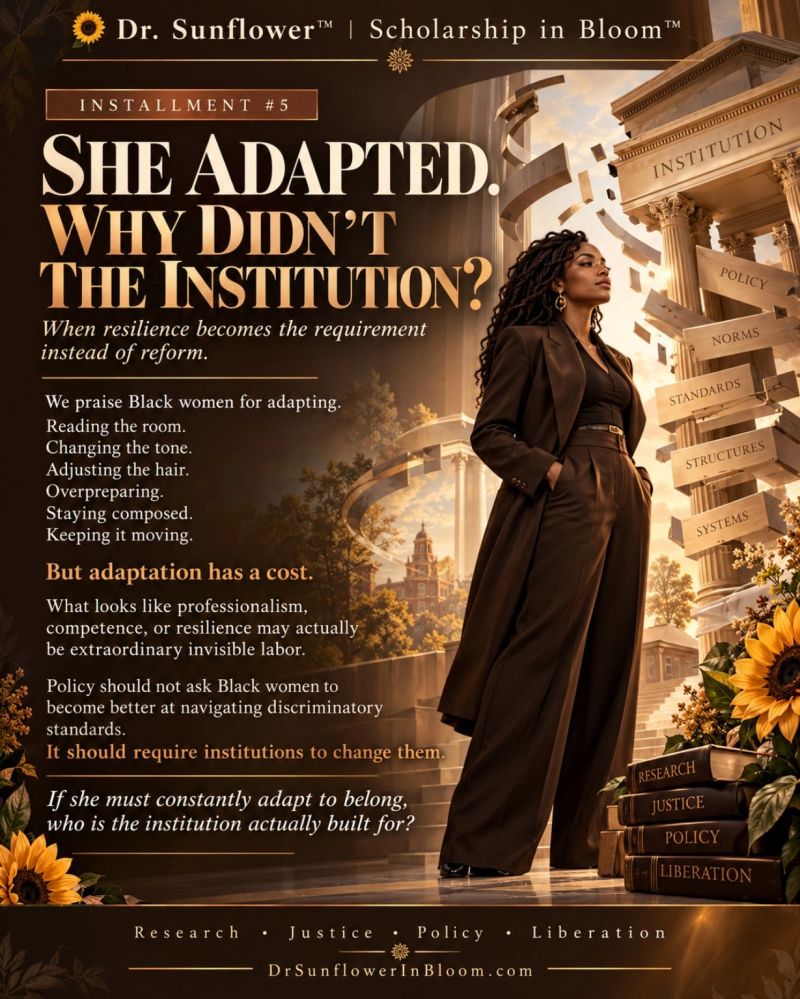
She Adapted. Why Didn’t the Institution? Scholarship in Bloom installment.
INSTALLMENT #5

She Adapted. Why Didn’t the Institution?

Adaptation can look individual while revealing the institutional expectations that made adaptation necessary.

Read the Essay →
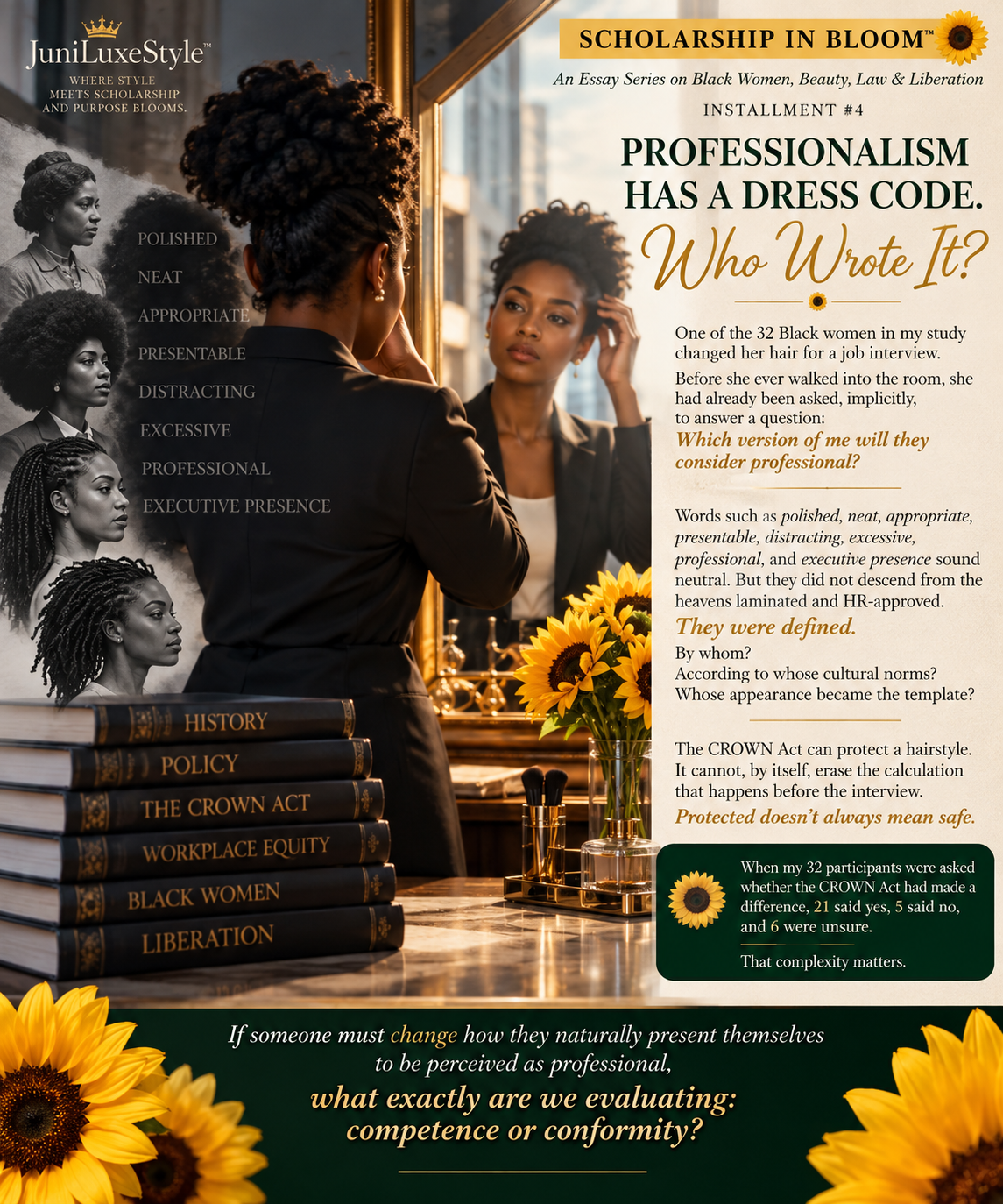
Professionalism Has a Dress Code. Who Wrote It? Scholarship in Bloom installment.
INSTALLMENT #4

Professionalism Has a Dress Code. Who Wrote It?

One participant changed her hair for a job interview before anyone reviewed her qualifications. What exactly are we evaluating: competence or conformity?

The Law Changed. Did the Gaze? Scholarship in Bloom infographic.
SCHOLARSHIP IN BLOOM™️

The Law Changed. Did the Gaze?

A law can prohibit discrimination. But can it change what people have been taught to see?

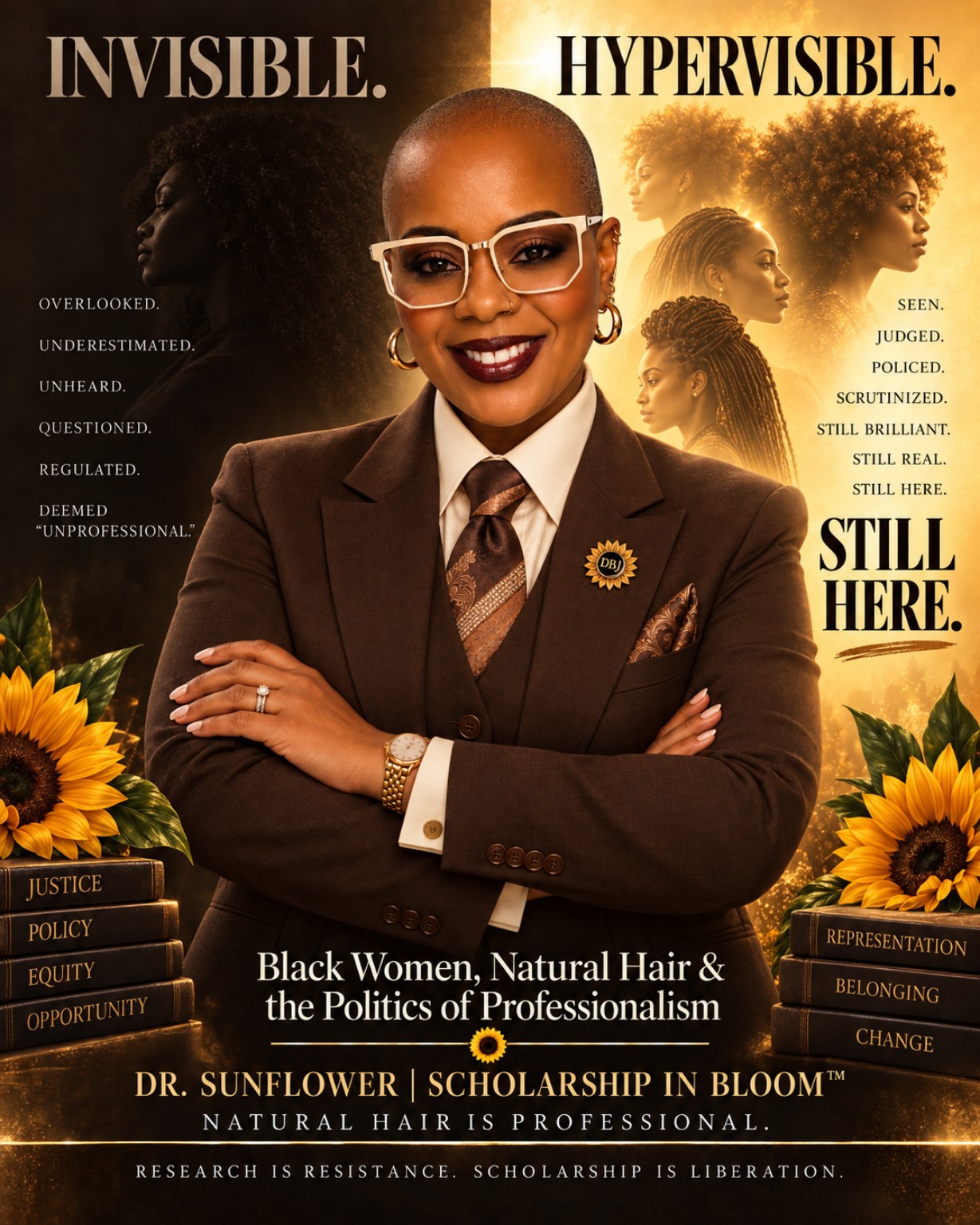
Thumbnail of the Invisible. Hypervisible. Still Here. scholarship poster.
FEATURED ESSAY

Invisible. Hypervisible. Still Here.

When Black women’s expertise can be overlooked while their hair remains subject to intense institutional scrutiny, visibility itself becomes political.

Read the Essay →
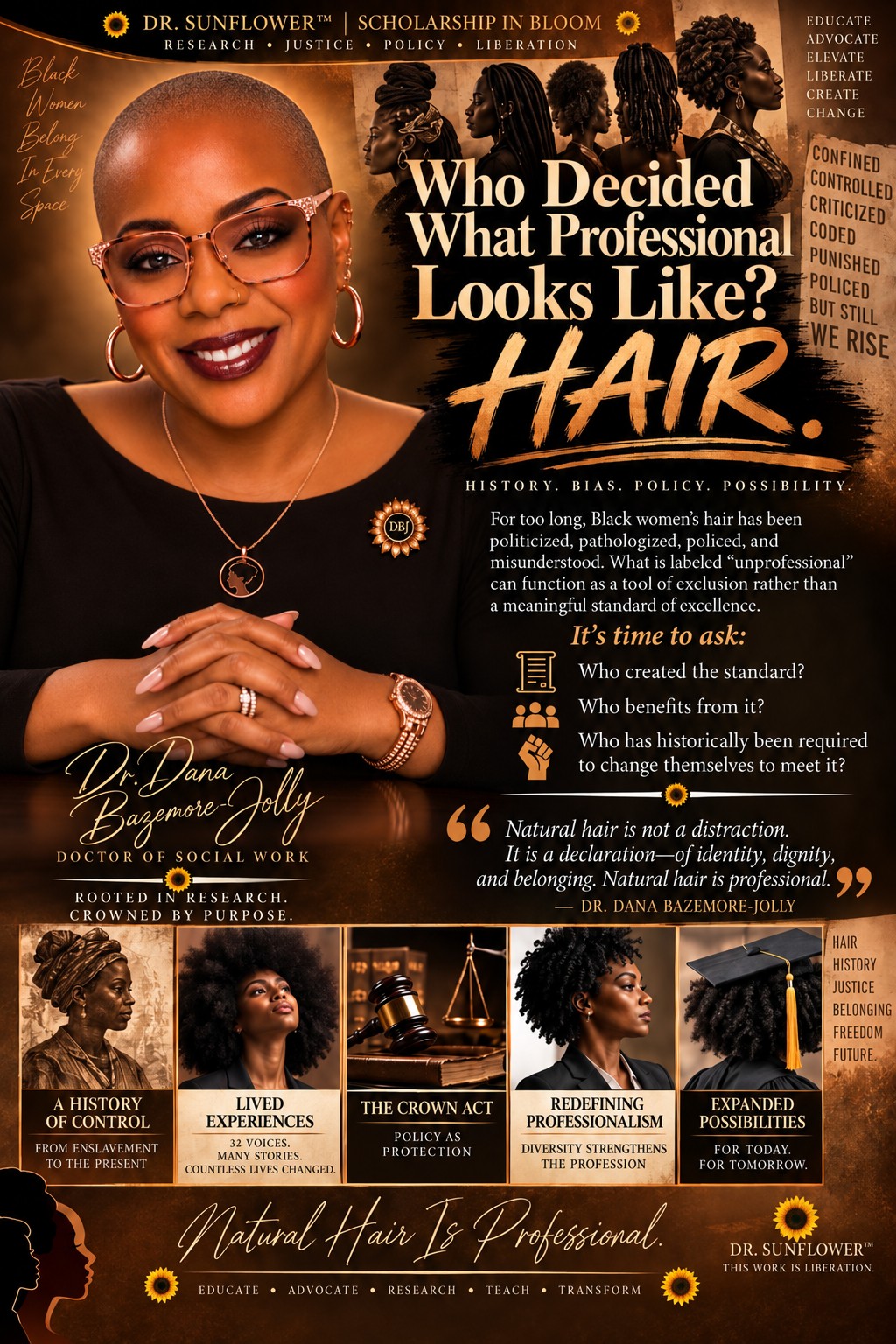
Who Decided What Professional Looks Like? HAIR. scholarship poster.
SCHOLARSHIP IN BLOOM™️

Who Decided What Professional Looks Like? HAIR.

Professionalism is often treated as though its standards emerged naturally. They did not.

SHE ADAPTED. WHY DIDN’T THE INSTITUTION?

When Black women must continually adjust themselves to navigate professional spaces, adaptation can become invisible labor.

She Adapted. Why Didn’t the Institution? Scholarship in Bloom installment examining adaptation, professionalism, natural hair, and institutional responsibility.

We often praise adaptation as resilience.

But adaptation can also tell us something about the environment requiring it.

A Black woman may change her hair before an interview, modify how she presents herself, or make strategic choices about what will be read as polished, appropriate, or professional.

Those decisions can look individual. They are also shaped by institutional expectations.

If she is always the one adapting, when does the institution have to change?

The CROWN Act matters because legal protection matters. But policy cannot do the work of institutional transformation alone.

Organizations must also examine the cultures, norms, practices, and definitions of professionalism that make self-modification feel necessary in the first place.

Adaptation should not become the admission price for belonging.

If she must constantly adapt to belong,
who was the institution actually built for?

🌻 Dr. Sunflower™️ | Scholarship in Bloom™️
Research • Justice • Policy • Liberation

Living • Learning • Becoming • Blooming

A visual mythology of identity, growth, power, and becoming. These collections imagine Dr. Sunflower Soul™️ across terrain, depth, bloom, movement, and transformation.

DR. SUNFLOWER™️ | SCHOLARSHIP IN BLOOM™️

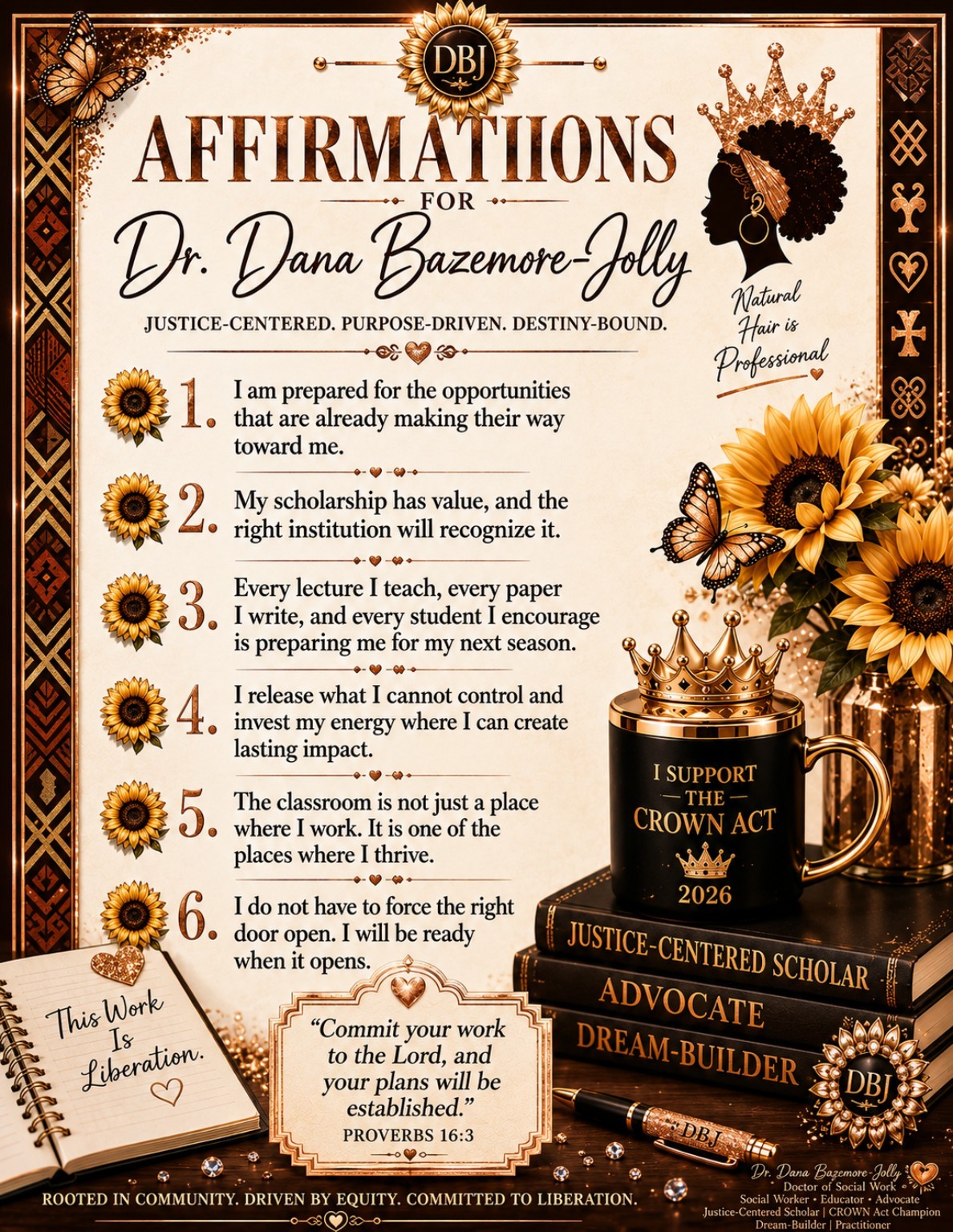
Affirmations for the Journey

Rooted in Purpose. Growing Through Scholarship.

Six affirmations that honor the work already underway and the opportunities still ahead.

Affirmations for Dr. Dana Bazemore-Jolly, a sunflower-and-gold poster featuring six declarations of readiness, scholarly value, teaching, purposeful energy, classroom belonging, and patience for the next opportunity.
Affirmations for Dr. Dana Bazemore-JollyTap or click the portrait to view it full-size.
Read the six affirmations
  1. I am prepared for the opportunities that are already making their way toward me.
  2. My scholarship has value, and the right institution will recognize it.
  3. Every lecture I teach, every paper I write, and every student I encourage is preparing me for my next season.
  4. I release what I cannot control and invest my energy where I can create lasting impact.
  5. The classroom is not just a place where I work. It is one of the places where I thrive.
  6. I do not have to force the right door open. I will be ready when it opens.
Explore the Soul collection

LAND • SEA • SUNFLOWER

Different Terrain. Same Soul.

Strength on land. Depth in the sea. Light in the bloom. Three visual languages, one evolving self.

Dr. Sunflower Soul™️ as a lioness-inspired expression of strength, strategy, compassion, leadership, and legacy.
LAND

The Lioness

Strength. Strategy. Compassion. Impact.

Dr. Sunflower Soul™️ in an underwater octopus-inspired expression of intelligence, adaptability, depth, and multidimensional possibility.
SEA

The Octopus

Depth. Adaptability. Intelligence. Possibility.

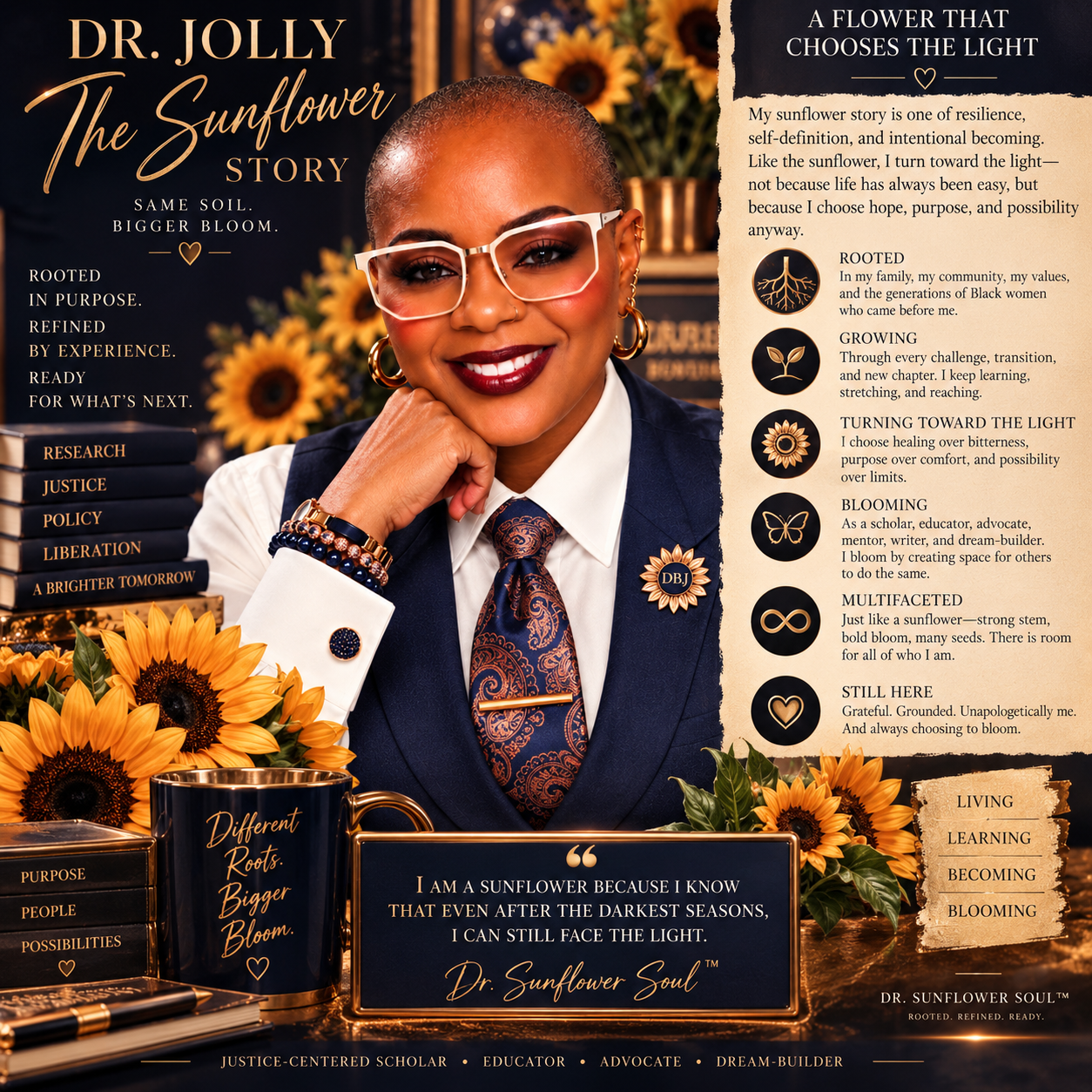
Dr. Sunflower Soul™️ surrounded by radiant sunflowers and warm golden light, representing rooted purpose, growth, becoming, and bloom.
SUNFLOWER

The Sunflower Story

Rooted in purpose. Turning toward the light.

CROWNED IN THE ELEMENTS™️

Dr. Sunflower Soul™️: Earth • Wind • Fire

I am the landscape, the breath, and the flame.

Crowned in the Elements™️ triptych featuring Dr. Sunflower Soul™️ as Earth, Wind, and Fire.
EARTH 🌿

ROOTED IN EVERYTHING THAT CAME BEFORE ME

I carry memory in my roots, wisdom in my soil, and possibility in everything I choose to grow.

WIND 🌬️

I LEARNED TO MOVE WITHOUT PERMISSION

I became spacious enough for change, light enough for becoming, and free enough to follow where my own spirit leads.

FIRE 🔥

I BECAME THE LIGHT I WAS LOOKING FOR

Not every flame destroys. Some illuminate. Some refine. Some reveal the woman who had been glowing beneath the surface all along.

I have been all three.

Earth, when life required me to root deeper than the storm could reach. I learned that becoming does not begin with blooming. It begins underground, where nobody applauds the work.

Wind, when what once held me could no longer contain me. I learned to loosen my grip on certainty, to trust movement, and to make room for versions of myself I had not yet met.

Fire, when survival was no longer enough. I learned that I could transform without disappearing. That heat could refine rather than consume. That sometimes the light at the end of the journey is the light you finally recognize within yourself.

I am rooted enough to remember.
Free enough to move.
Lit enough to become.

I am not one element.
I am the landscape, the breath, and the flame.

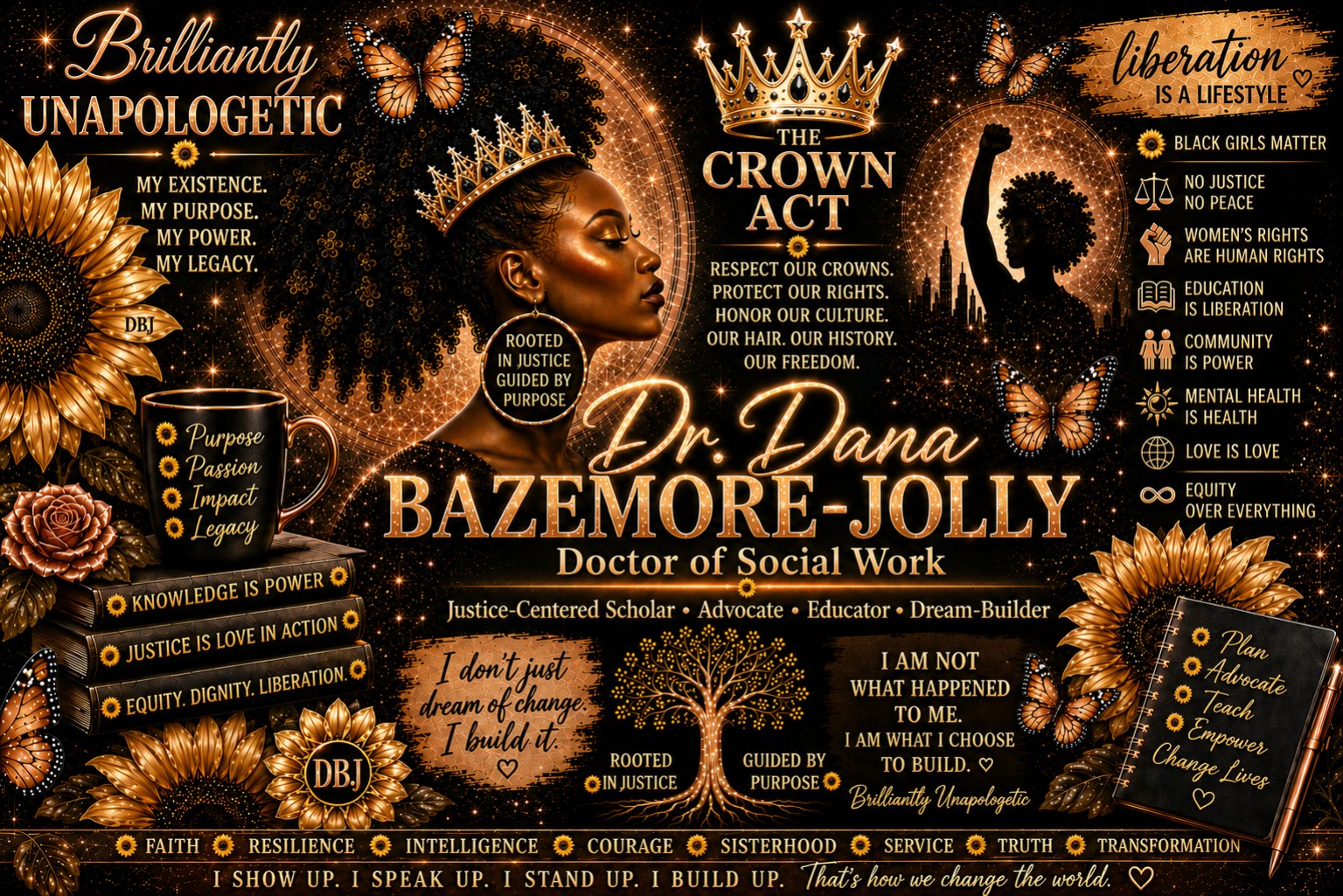
Brilliantly Unapologetic

Brilliantly Unapologetic: a gold and black landscape artwork honoring Dr. Dana Bazemore-Jolly, Doctor of Social Work, with a crowned Black woman, sunflowers, butterflies, CROWN Act advocacy, and declarations of justice, purpose, community, and liberation.
Rooted in justice. Guided by purpose. Brilliantly unapologetic.

Justice is our foundation.
Community is our purpose.
Compassion is our practice.

JusticeLuxe™ Social Work is a justice-centered philosophy of social work grounded in dignity, self-determination, liberation, and an orientation toward abundance rather than austerity.

It asks social work to imagine beyond what is minimally acceptable toward what is humanly possible.

JusticeLuxe™ Social Work emblem featuring three Black women, a globe, supportive hands, scales of justice, and a sunflower.
Explore JusticeLuxe™ Social Work →

A QUESTION WORTH CARRYING WITH YOU

What if some institutional standards were never designed with all of us in mind?

Scholarship begins with curiosity. Justice-centered scholarship goes one step further: Who benefits from the answer? Who has been missing from the question? And what becomes possible when those voices are finally centered?

Continue the Conversation.

Scholarship does not end when something is published. Publication can be where the conversation begins. Explore the featured LinkedIn essay, published commentary, and new installments of Dr. Sunflower™️ | Scholarship in Bloom™️ alongside research reflections, policy conversations, and justice-centered scholarship.

Read the Featured Essay on LinkedIn

More public scholarship and archive entries will be added as Scholarship in Bloom™️ grows.

I Wear Pink.

Dr. Dana Bazemore-Jolly wearing a tailored pink vest pantsuit, coordinating shirt and necktie, and pink embellished sneakers, surrounded by pink awareness ribbons and sunflower accents. The banner honors survivors, remembers loved ones, and supports early detection, hope, and healing.

I wear pink in honor of every woman and family touched by breast cancer. For the survivors, for those still fighting, for those we carry in memory, and for every life that may be changed by early detection. May we continue to lead with awareness, compassion, hope, and love. 🎀🌻

— Dr. Dana Bazemore-Jolly

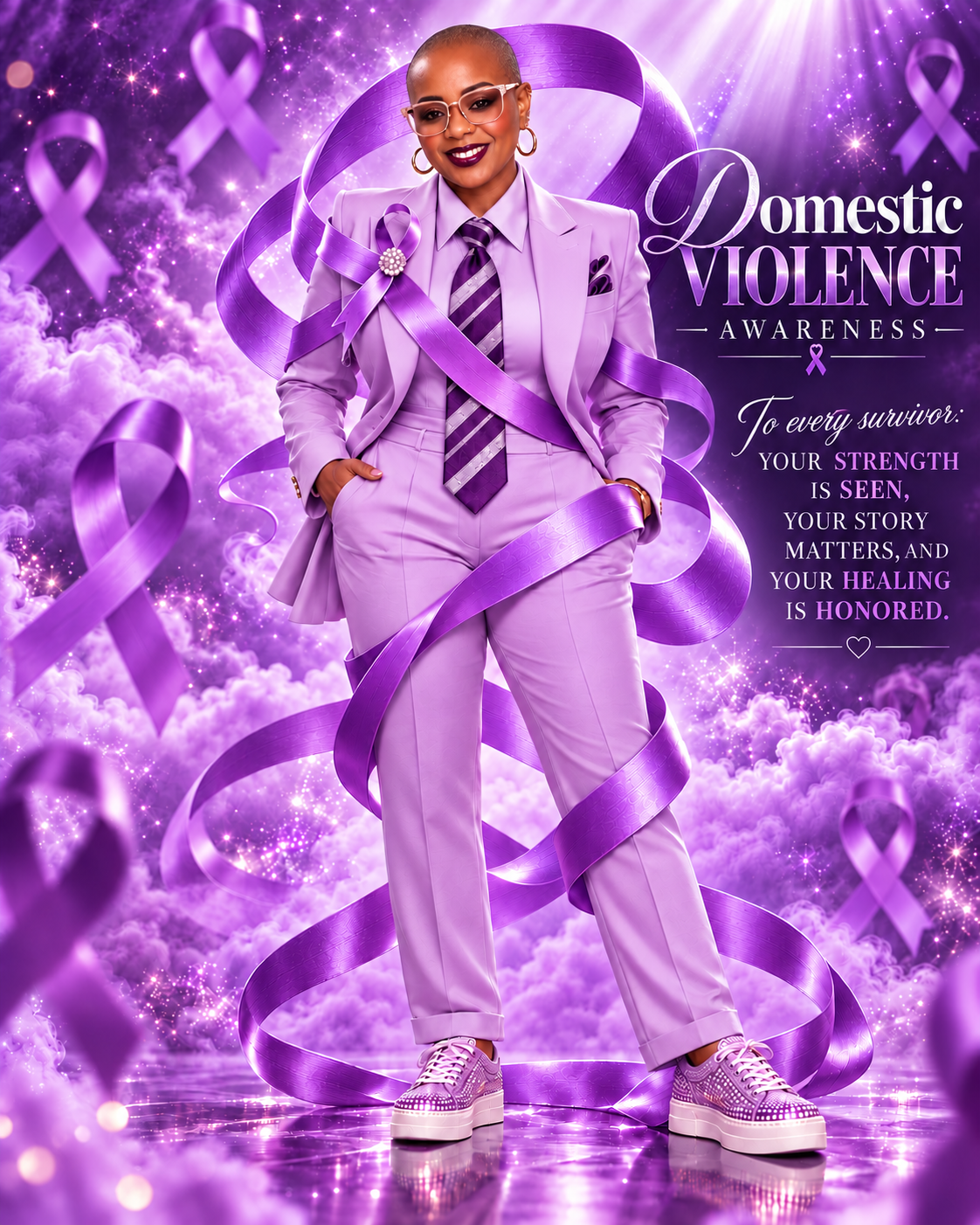
I Stand in Purple.

For safety. For dignity. For every survivor.

Domestic Violence Awareness artwork featuring Dr. Dana Bazemore-Jolly in a lavender pantsuit, striped purple tie, glasses, gold hoop earrings, and purple embellished sneakers, surrounded by flowing purple awareness ribbons, with the message: To every survivor, your strength is seen, your story matters, and your healing is honored.

Every person deserves safety, dignity, compassionate support, and the freedom to live without fear.

This tribute stands with survivors of intimate partner violence, honors stories held in silence, and affirms the right to healing, protection, and choice.

— Dr. Dana Bazemore-Jolly